

| Devine Municipal Court 303 S. Teel Dr., Devine, TX 78016 Phone: 830-663-2804 Fax: 830-663-2208 Email: court@cityofDevine.com |
Presiding Judge: Anna L. Whorton
Prosecutor: Bobby Jack Rushing
Court Administrator: Cassandra Maldonado
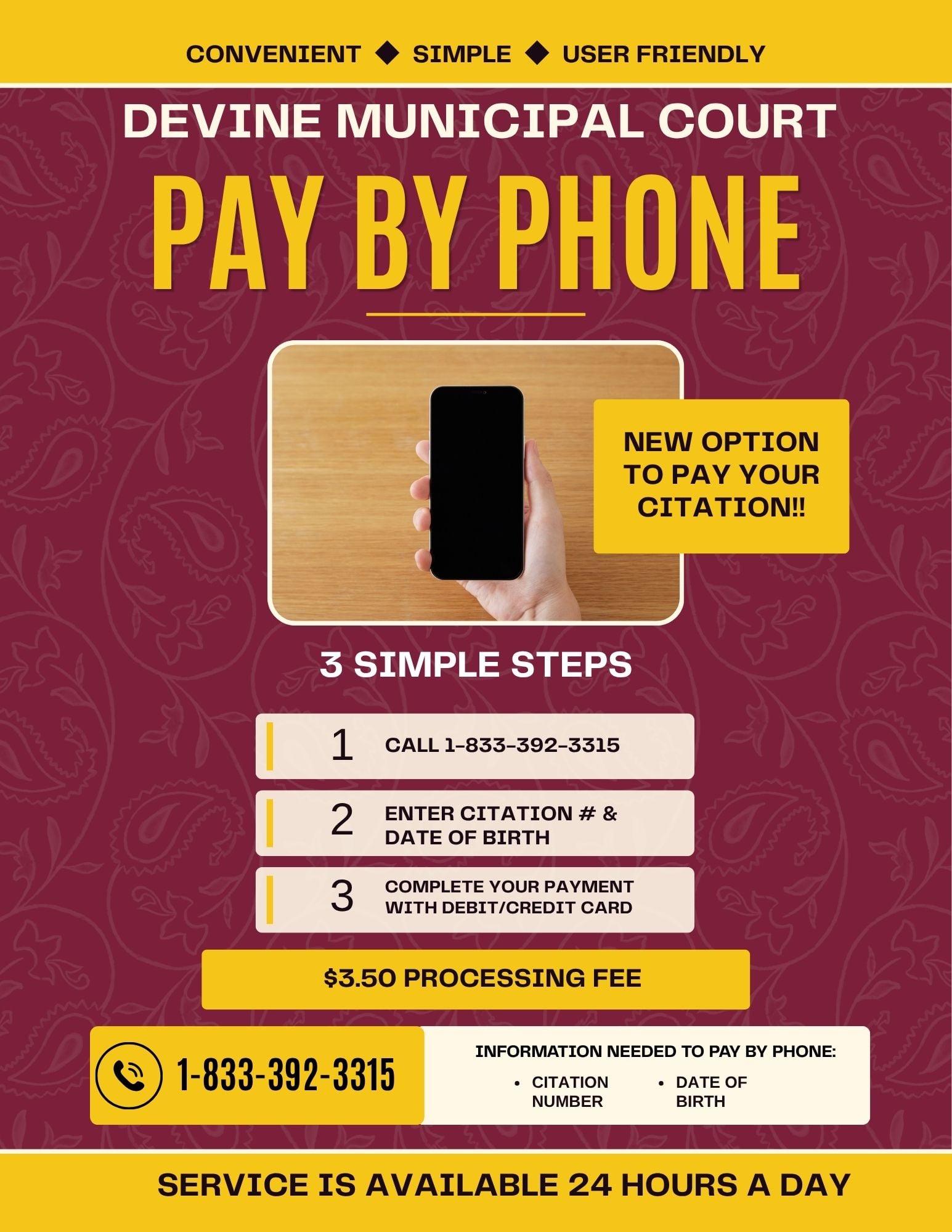
Fast & Easy Citation Payment Now Available – (View Details)
Active Warrant List As Of September 2026 – (View Details)
Court Handout – June
Court Handout – June (Spanish)
|
Note: The Judge and Prosecutor are only here on court day. If you want to speak with either one of them, make sure you appear on your scheduled court date. Remember! Discussing any facts of the case with the judge or prosecutor that would hinder them from determining final judgment is considered ex parte communication. |
The Devine Municipal Court only handles citations or cases generated by the Devine Police Department. If the Department of Public Safety issued your citation, contact their office at 830-665-8020.
COURT PROCEEDINGS
-
- Court proceedings are generally held on the third Thursday of every month.
-
- Monthly court dockets are posted at City Hall forty-eight hours before court day.
-
- Currently, the Municipal Court is being held at The George S. Wood Community Center, 200 E. Hondo Ave., Devine, TX 78016.
-
- Bench/Jury trials are scheduled as needed.
-
 All persons entering the courtroom should be dressed in clothing reasonably befitting the dignity and solemnity of the courtroom proceedings (e.g., shorts, flip-flops, tank tops, or T-shirts are not permitted).
Range of fines
The facts and circumstances of each case determine the amount of fine the court assesses. Mitigating circumstances may lower the fine, even if you are guilty. On the other hand, aggravating circumstances may increase the fine.
Range of Punishment/Fines:
-
- Traffic Code Violations: $1–$200
-
- Class C Penal Code Violations: $1–$500
-
- Class C Violations Outside Penal Code: $1–$1000
-
- City Ordinance Violations: $1–$2000
The fine does not include court costs, which vary from case to case. You will be expected to pay the fine and court costs at the time your case is heard. Court costs must be paid regardless of whether you have appeared in court.
-
- Mailed payments must include court costs.
-
- State law requires an additional $15 to be added to each case for any fine not paid within 30 days of judgment.
-
- An extra $25 will be added to any offense in a school zone.
Appearance
-
- A defendant 18 or older may appear in person, by mail, or by e-mail (depending on the charge and options available to the defendant) A phone call DOES NOT constitute an appearance.
-
- Juveniles and minors in alcohol/tobacco-related offenses must appear in person with a parent or guardian.
-
- Family Violence Offenses require in-person appearance.
juveline & minor Appearances
-
- A juvenile or a minor in alcohol or tobacco-related offenses may only appear in person with their parent or guardian.
pleas
-
- Under our American system of justice, all persons are presumed innocent until proven guilty.
-
- Guilty Plea:
-
- Admit guilt and accept responsibility.
-
- Understand that:
-
- The State must prove you violated the law.
-
- You may hear the State’s evidence.
-
- Your plea may be used in a later civil case.
-
- Understand that:
-
- Admit guilt and accept responsibility.
-
- Guilty Plea:
-
- No Contest (Nolo Contendere):
-
- Do not contest the charge; usually results in a guilty finding unless deferred or defensive driving is granted.
-
- Cannot be used against you in a civil case.
-
- No Contest (Nolo Contendere):
-
- Not Guilty:
-
- Deny guilt or claim a defense.
-
- The State must prove guilt beyond a reasonable doubt.
-
- Decide whether to hire an attorney or represent yourself.
-
- Not Guilty:
defensive Driving
-
- May prevent an offense from appearing on your driving record.
-
- Requirements:
-
- Driver’s license
-
- Insurance card
-
- Affidavit that no course has been taken in last 12 months
-
- Requirements:
-
- Court costs + $10 admin fee required upfront.
-
- 90 days allowed to complete course and submit proof + driving record.
-
- Obtain driving record via DPS form or online at www.dps.texas.gov.
Deferred Disposition
-
- Available for defendants age 25+.
-
- Probation: 1–180 days.
-
- Terms determined by judge.
-
- Court costs due upfront; fines due by end of deferral period.
-
- Non-compliance adds charges and reports to DPS.
Presenting the Case at trial
-
- The State presents its case first.
-
- Defendant may cross-examine witnesses.
-
- Defendant may testify but cannot be compelled to.
-
- After testimony, both sides give closing arguments.
Businesses
Local merchants within Devine may file NSF checks with the Municipal Court. Contact the court clerk for info.
Resources
-
- Resources
-
- Municipal Court Docket: posted monthly at City Hall.
-
- Youth Diversion Program: Youth Diversion Flowchart (PDF link).
-
- External Resources:
-
- DPS Driver Records – www.dps.texas.gov
-
- Pay Delinquent Fines – www.paymvba.com
-
- External Resources:
Jury Service
Why is Jury Service important?
The United States Constitution and the Texas Constitution guarantee all people the right to trial by an impartial jury of their peers, regardless of race, religion, sex, nation origin or economic status.
What is my duty as a Juror?
As a juror, you must be fair and impartial. Your actions and decisions must also be free of any bias or prejudice because your actions and decisions are the foundation of our judicial system.
Am I eligible?
Jurors must be:
-
- A citizen of the United States.
-
- A resident of the City of Devine.
-
- At least 18 years of age.
-
- Able to read and write the English language.
-
- Of sound mind.
You cannot serve on a jury if you:
-
- If you are in doubt or think you may not be qualified to serve on a jury for one of the above or any other reasons, please notify the judge.
-
- Have been convicted of a felony or of any type of theft offense (unless your rights have been restored);
-
- Are now on probation or deferred adjudication for a felony or for any type of theft; or
-
- Are now under indictment for a felony or are now under criminal charges for any type of theft.
How was I selected?
You were selected at random from the current Voter’s Registration list for the City of Devine.
Who can be excused from Jury Service?
You are entitled to be excused as a juror if you:
-
- Are over 75 years of age;
-
- Have legal custody of a child under 10 years of age and jury service would leave the child unsupervised;
-
- Are a student in class;
-
- Are the caretaker of a person who is unable to care for themselves (an invalid); or
-
- Can show a physical or mental impairment or an inability to comprehend to communicate in English.
There is a penalty for jurors failing to respond to summons. A juror may be fined up to $100 if he: 1) fails to attend court in disobedience to the notice without reasonable excuse; or 2) files a false claim of exemption from jury service.
What are The Different Types of Cases?
There are two basic types of cases, criminal and civil (including family cases).
-
- Criminal Cases:
A criminal case results when a person is accused of committing a crime. You , as a Juror, must decide whether the person charged is guilty or not. The accused person is presumed innocent and the State, represented by the city prosecutor, must prove the defendant is guilty “beyond a reasonable doubt.”
- Criminal Cases:
-
- Civil Cases:
A civil case results from a disagreement or dispute between two or more private parties. In a civil case, you, a juror, must answer questions of disputed facts based upon the testimony and evidence admitted by the Judge. The answers to these questions are called the verdict. Note: Municipal Court does not hear civil cases.
- Civil Cases:
Will I be paid for being a Juror?
Yes. You will be paid $6.00 for appearing for the jury “venire” or pool and if you are selected, to serve on the jury, $10 for each day you actually serve.
Must my employer pay me while I am on Jury Duty?
Your employer is not required to pay you while on jury duty. However, employers are prohibited by law from firing an employee for serving as a Juror. An employee whose employment is terminated in violation of this section is entitled to return to the same employment that was held when summoned for jury service if the employee, as soon as practical after release from jury service, gives the employer actual notice that the employee plans to return. (Civil Practice and Remedies Code, section 122.001).
Who Can Have a Jury Trial?
Any person charged with a criminal offense or any party to a civil case has a right to a jury trial. All parties are equal before the law and each is entitled to the same fair treatment.
Are There Rules about Jury Conduct?
Yes. The Texas Supreme Court has rules to assist you in your conduct as a Juror which will be given to you by the Judge.
How is a Juror Selected for a Particular Case?
Cases will be heard by juries of 6 jurors. A larger group, called a panel, will be sent to the trial court (courtroom) where the jurors will be questioned (Voir Dire Process) under the supervision of the judge.
A juror may be excused from the panel if it is shown that the juror cannot act impartially concerning the case to be heard. In addition each side is allowed to remove a given number of jurors from the panel without having to show any reason. The trial jury will be the first 6 of the remaining jurors on the panel.
What is Voir Dire or Questioning of the Jury Panel?
It is a way for the parties to select a fair and impartial jury. Under the justice system, you may be questioned by each of the lawyers before they decide to remove a certain number of jurors from the jury panel.
For example, the lawyer may ask you questions to see if you are connected to the trial or if you have any prejudice or bias toward anyone in the trial. These questions are not intended to embarrass you, but rather to help the lawyers in the jury selection process. You may ask the judge to allow you to answer some questions away from the other jurors.
What if I have a Special need or Emergency?
After you have been selected as a juror on a trial panel, if you have a special need or an emergency, tell the bailiff.
How do we act during the trial?
A court session begins when the court officer raps for order. Everyone in the court rises. The judge takes his or her place on the bench and the court officer announces the opening of the court. A similar procedure is used when court adjourns. Common courtesy and politeness are safe guides as to the way jurors should act. Of course, you will not be permitted to read newspapers or magazines in the courtroom, nor should you carry on a conversation with another juror in the courtroom during the trial.
You will be treated with consideration and your comfort and convenience will be served whenever possible. If there is an emergency or a matter affecting your service, you should bring it to the attention of the judge. In the event of a personal emergency, notify the judge through any court personnel or you may ask to see the judge privately.
You must give close attention to the testimony. You are sworn to disregard your prejudices and follow the Court’s instructions by rendering a verdict according to your best judgment. You should keep an open mind. Human experience shows that once a person comes to a preliminary conclusion to a set of facts, they hesitate to change their view.
Similarly, jurors should not discuss the case even among themselves until it is finally concluded. Therefore, it is wise for you not even to attempt to make up your mind on the facts of a case until all the evidence has been presented to you and you have been instructed on the law applicable to the case. Also keep in mind that proper clothing is required. All persons entering the courtroom should be dressed in clothing reasonably befitting the dignity and solemnity of the courtroom proceedings (e.g., shorts, flip-flops, tank-tops, or T-shirts are not permitted).